
A muse is usually imagined as someone outside the self. She appears beside the artist, beneath his gaze, inside his work, and often at the expense of her own name. History has loved the image of the muse because it is romantic, but it has also been careless with her. Too often, the woman who inspired the work was remembered only as inspiration, while her intelligence, agency, and creative life were treated as secondary.
This is one of the quiet tragedies of the artist-muse relationship. The muse becomes symbolic before she is allowed to remain human. She is turned into a mirror, a mystery, a wound, a temptation, a color, a season, or a face in a painting. The artist extracts from her what belongs to his vision, and when she begins to exist beyond that vision, he often resents her for becoming real.
Lou Andreas-Salomé understood this danger. Although she moved among some of the most significant intellectual figures of her time, her own body of work was often eclipsed by the men who loved her, studied with her, or projected meaning onto her. She was treated by many as a muse, but she resisted the smallness of that title when it meant becoming an ornament to someone else’s genius. She was not merely a beautiful woman moving through the minds of great men. She was a thinker in her own right.

Her writing on narcissism is especially compelling because she did not accept the idea that self-absorption was only a moral failure. The myth of Narcissus is usually read as a warning against vanity: a young man falls in love with his reflection, cannot look away, and is destroyed by the image of himself. This interpretation is not wrong, but it is incomplete. Salomé saw another possibility within the myth. She understood that the encounter with one’s own reflection could also be an entrance into the self.
There is a form of looking at oneself that is shallow, and there is a form of looking at oneself that is sacred. The first is vanity. The second is self-knowledge. One remains on the surface, admiring the familiar image. The other recognizes the image as a doorway and dares to ask what lies beneath it.
To be one’s own muse is to take this risk. It is to become both the artist and the figure who awakens the artist. It is to stop waiting for someone else to name your beauty, interpret your mystery, or turn your life into meaning. It is to understand that the self contains its own symbolic force. The woman who becomes her own muse does not ask to be discovered. She begins the work of discovering herself.
The mirror is essential here. Venus is often shown with a mirror, and Narcissus has his pool of water. These are not simply instruments of vanity. They are symbols of reflection, and reflection is the beginning of art. To reflect is to pause, to look again, to allow an image, memory, or experience to become conscious.
A river moves, and in its movement it suggests forgetting. A lake remains still, and in its stillness it offers memory. This distinction matters because creation requires a kind of stillness. We cannot make meaning from life while rushing through it without contemplation. Art begins when experience stops moving long enough to be seen.
Without memory, there is no creation. The Greeks understood this by making Mnemosyne, the goddess of memory, the mother of the Muses. Before poetry, before music, before history, before dance, before astronomy, there is memory. The artist does not create from emptiness. She creates from what has been remembered, wounded, desired, preserved, and transformed.
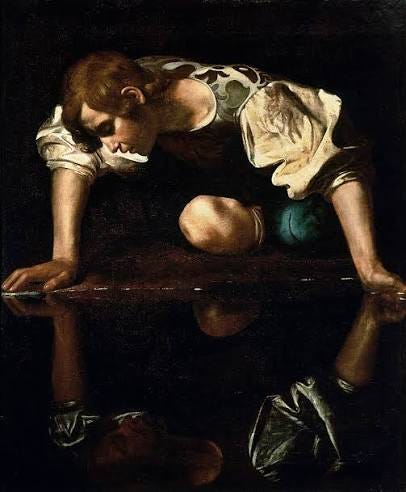
This is why the image of Narcissus looking into the water can be read differently. Perhaps he is not only admiring himself. Perhaps he is searching for the part of himself he has lost. The face in the water is familiar, but it is not fully known. It looks like him, but it also contains the mystery of him. The reflection lures him downward, not merely into self-love, but into self-recovery.
To become your own muse is to follow that reflection without mistaking the surface for the whole. The surface may attract you first. Beauty often does. But beauty, when taken seriously, is rarely only surface. It becomes an invitation to enter more deeply into the self, into memory, into the hidden architecture of desire.
This is where the feminine approach to the muse becomes so powerful. The creative woman does not always need to externalize her longing into another person. She can turn inward and find there the image, the voice, the figure, and the mystery she seeks. She can become both the one who looks and the one who is looked upon. She can be the artist, the subject, the witness, and the work.
There is great freedom in this, but also danger. Our culture is increasingly obsessed with self-expression, yet often stops at the most superficial layer of the self. We confuse self-knowledge with personal branding, confidence with vanity, boundaries with selfishness, and individuality with whatever is currently fashionable. The language of becoming oneself can easily degrade into the performance of being seen.
That is not what I mean by being your own muse. To be your own muse is not to worship your image. It is to listen for the part of yourself that has been waiting beneath the image. It is not simply asking, “How do I look?” It is asking, “What am I trying to remember?” It is the difference between staring at the mirror and entering it.
There is an ancient feeling that our lives are a journey back toward something familiar. People call it home, destiny, essence, selfhood, or divine order. Whatever the name, the feeling is the same. We sense that there is a more complete version of ourselves somewhere ahead of us, although strangely, it also feels as if it existed before us. Becoming does not always feel like invention. Sometimes it feels like memory.
This is why self-discovery can feel like returning home. The person you are trying to become often feels familiar before she is visible. You do not know her fully yet, but you recognize her presence. She appears in your taste, your longings, your private standards, the images that haunt you, the beauty you cannot stop pursuing. She is the other self in the water, the one who looks like you but knows more.

The muse, then, is not always another person. Sometimes the muse is the completed self calling from beneath the surface. She is the whisper that tells you what to study, what to wear, what to make, what to refuse, what to pursue, and what must be left behind. She is not separate from you, but she is not yet fully you either. She is the higher self made intimate.
This is why becoming your own muse requires discipline. You must be willing to observe yourself without collapsing into vanity. You must be willing to admire yourself without becoming shallow. You must be willing to descend into memory without becoming trapped there. The mirror is useful only if it leads to transformation.
The artist who depends entirely on an external muse often risks turning another human being into raw material. He wants her mystery, but not her freedom. He wants her beauty, but not her will. He wants the part of her that awakens him, but not the whole person who may contradict him, disappoint him, or belong to herself. This is the failure of the muse when she is made into an object.
But when the muse is internal, the relationship becomes more honest. There is no one to possess. There is no one to reduce. There is only the long, difficult communion with the self. The woman who becomes her own muse accepts that the source of inspiration is not something she must seduce from the outside world. It is something she must cultivate within.
This does not mean isolation. It does not mean refusing influence, love, admiration, or artistic communion with others. It simply means that the center is no longer outsourced. The world may inspire you, but it does not author you. Other people may awaken something in you, but they are not responsible for giving you yourself.
There is danger in going inward, of course. Not everyone likes what they find. The self is not only beauty, grace, intuition, and longing. It also contains fear, envy, shame, hunger, memory, grief, and strange private darkness. To be your own muse is not to encounter only the flattering parts of yourself. It is to risk meeting the whole interior world and still choosing to create from it.
The reward is wisdom. The reward is intimacy with your own becoming. The reward is learning that the voice you mistook for some distant goddess was often your own voice, refined by memory and made strange by depth. The Muses were said to whisper into the ears of those who invoked them. I believe in such whispers. I simply no longer believe they always come from somewhere else.
To be your own muse is to hold your own hand on the way back to yourself. It is to look into the still water and understand that the reflection is not the end of the journey, but the invitation. It is to become curious about the self beneath the self, the face beneath the face, the memory beneath desire. It is to know that beauty is not only something to be admired, but something that can lead you inward.
The woman who lives for beauty must eventually learn this. She cannot spend her life waiting to be seen by the artist, the lover, the world, or the gaze of another person. She must become the one who sees. She must become the one who remembers. She must become the one who creates meaning from the image staring back at her.
The muse is not gone. She has simply moved closer. She is no longer across the room, draped in someone else’s imagination. She is inside the mirror, inside the memory, inside the disciplined act of becoming. And when she whispers, she does so with a voice that is unmistakably your own.